Cambridge Analytica already laid out this game back in 2009: target the swing voters. And the propagandists did just that.
What's not shown here are the numbers for those who fell for the apathy "don't vote it doesn't matter" pitch. That skews heavily toward young people as well.
Cambridge Analytica already laid out this game back in 2009: target the swing voters. And the propagandists did just that.
What's not shown here are the numbers for those who fell for the apathy "don't vote it doesn't matter" pitch. That skews heavily toward young people as well.
what's most troubling about that graphic is the vote totals. gen z black men accounted for less than 1m total votes. latino men slightly less than 2m and white men a little over 6m.
The Cuban community, which voted massively for the president in the November elections, is confronting a longstanding tradition of supporting conservative policies
english.elpais.com
Florida’s Cubans are now divided on Trump: ‘He acts like Fidel’
The Cuban community, which voted massively for the president in the November elections, is confronting a longstanding tradition of supporting conservative policies
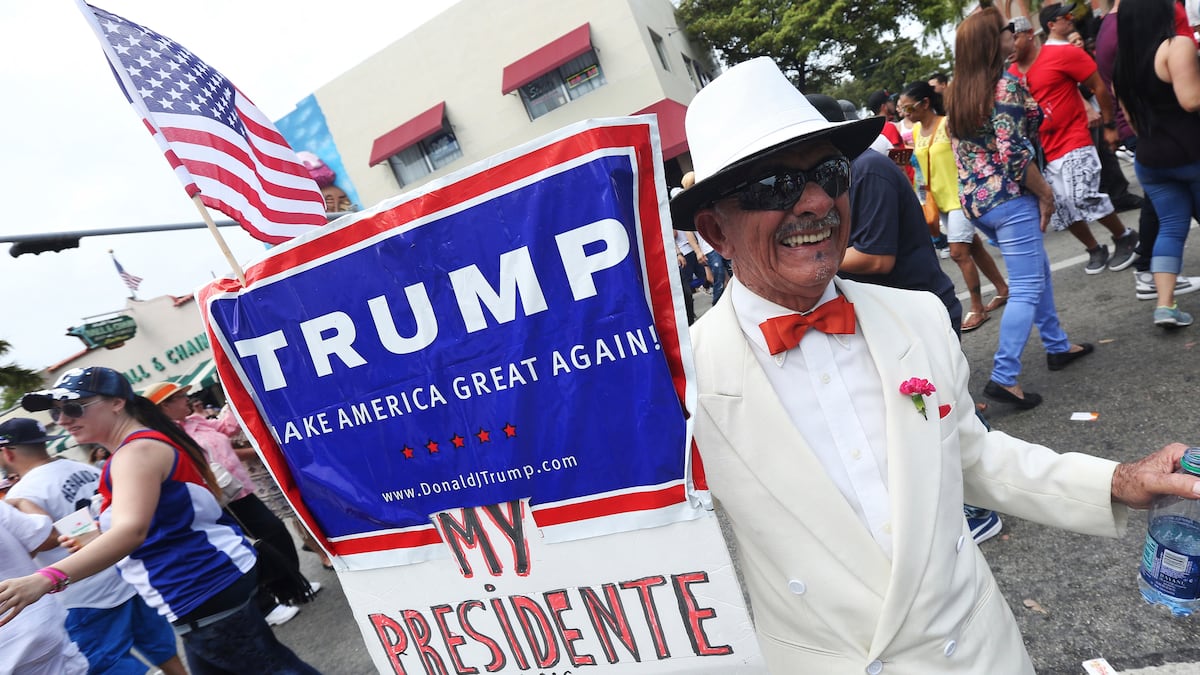
A Cuban migrant shows his support for Trump in Miami.Sean Drakes (LatinContent via Getty Images)
United States Citizenship and Immigration Services (USCIS), the agency in charge of processing immigration applications, goes around asking coworkers and neighbors whether someone is eligible for U.S. citizenship or not, in the style of the Cuban Committees for the Defense of the Revolution (CDR). The American government attacks the LGBTQ+ community… just like the Cuban government did in the 1960s. Donald Trump has flirted with staying longer in the White House, in the same way in which Fidel Castro — having tasted so much power during his lifetime — decided to lead Cuba for nearly half a century. The former has already devoted efforts toward attacking opposing ideologies and freedom of expression, concepts that the latter completely nullified. One man worships what the other turned into a religion: exaltation, maximum control, a sea of fanatics, as well as the certainty that there’s no reason for the “dictator” label.
These comparisons are, among other reasons, why Carlos Icaza, a 63-year-old Cuban-American barber (almost the same age as the Revolution), finds it inconceivable that a large part of his community in the United States still defends the Republican. He knows a dictator when he sees one. “Cubans have never known what a democracy is,” he asserts. “They need a [strong]man to tell them what to do.”
He’s not the only one who thinks so. Daimarys Hernández, a manicurist whose husband is about to be deported from the Krome Detention Center in Florida, finds it incredible that her people “don’t understand how a dictator acts.”
“The same Cubans who have been here for years don’t realize that Trump acts the same way as Fidel did,” she adds.
It’s been almost nine months since Trump was sworn into office. In the 2024 presidential elections, 68% of Cuban-Americans in Florida gave the Republican their vote. However, since his return to power, those arriving from the island have not been exempt from deportations, self-deportations, the denial of political asylum, confinement in detention centers, as well as fear of what might happen to them when they go to work or school, or when they enter or leave the country.
Jorge Duany, former director of the Cuban Research Institute (CRI) and professor of anthropology in the Department of Global & Sociocultural Studies at Florida International University (FIU), believes that, to date, there’s insufficient evidence that voters have changed their preference for the current U.S. leader.
“The available polls show that the majority of voters in the last presidential election would vote the same way if the election were held today,” he points out.
Jessica Ruiz, however, no longer falls into that group. She wouldn’t recast her vote for Trump. “I voted with the hope that his administration would bring real improvements to the economy, more job opportunities and a more stable future for our families,” she sighs. “But as the months have gone by, my experience has been very different from what I expected. Instead of feeling more security and progress, I’ve seen an environment of division, decisions that don’t always favor ordinary workers, and an economy that hasn’t felt as strong as he promised. Today, with the clarity that experience gives me, I can say that if I had the opportunity to withdraw my vote, I would.”
At first glance, nothing has changed in Florida since the Biden administration concluded back in January. Egg cartons are just as expensive. Gasoline prices haven’t gone down. Rent is rising daily. These were the issues that Cuban-Americans were concerned about and voted on in the November elections, a time when — unlike other years when Cuba policy steered their vote — they were most concerned about the country’s economy. This, at least, is according to a survey by FIU. After nine months in office, however, Guillermo Grenier, the sociologist at FIU who led the survey, affirms that Trump “hasn’t delivered on his promises to reinvigorate the economy.”
“The economy is much worse now than when Biden left office,” he says. But Grenier insists that this fact doesn’t mean the community “feels let down,” nor does it guarantee “a widespread departure from Trumpism or the Republican Party.”
Still, beyond the price of gas, eggs and rent, Florida today is also a very different place than it was a few months ago. At Miami International Airport, several Cubans have already received warnings or threats about having their green cards revoked when traveling to Cuba. Others have been detained by ICE agents outside immigration court. There’s no shortage of divided families, where an uncle who voted for Trump has his nephew on the verge of deportation. In just eight days, the most feared prison of the Trump era — the South Florida Detention Facility, nicknamed “Alligator Alcatraz” — was built in their backyard. There, several Cubans have ended up suffering the nightmare of rampant mosquitoes, a lack of food, and unhygienic conditions.
None of this, according to locals, had ever happened to them before. But in the Sunshine State, just as some are disappointed, there are also those who profess the religion of every man for himself.
A few days ago, Daimarys had a client come to get a hand and foot treatment. “She told me, ‘[We should] deport everyone who doesn’t have papers.’” Daimarys confronted her: “Why are you talking like this? Because you have papers? They’re illegal because they don’t have the opportunities we Cubans had. But those people come here to do the work that neither my children or yours — who were born here — will ever do.”
“I never imagined that, after leaving Cuba, I would experience what we’re experiencing here”
The Trump administration — in an initiative led by Secretary of State Marco Rubio, the former senator from Florida who is of Cuban descent — has enacted several measures in recent months aimed at suffocating Havana. This was, and has always been, another means of securing the Cuban vote in Florida. But the truth is that Cuba isn’t at the center of Oval Office conversations. Trump isn’t offering millions of dollars for Miguel Díaz-Canel’s arrest (like he is for Nicolás Maduro), nor has he managed to satisfy the long-standing desire to overthrow the dictatorship.
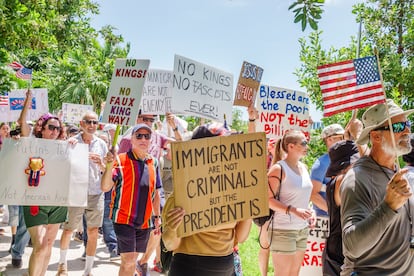
‘No Kings’ protest against Trump in Miami, Florida, on June 14.Jeff Greenberg (Universal Images Group / Getty Images)
Cubans — who have experienced an exodus of nearly two million people from the island in recent years — haven’t lost hope of moving to the U.S. According to a study by the Cuban Observatory of Human Rights (OCDH), 78% of those interviewed still want to emigrate, amid a crisis that has affected all levels and sectors of society. Due to the benefits that the community has received in the United States for decades, the majority prefer this country as a destination. But now, the chances of arriving are almost zero, amid a national expulsion campaign.
Based on data from recent months, the outlook for the Cuban community in the U.S. is as follows: 4,248 have been deported to the island, the highest number ever. Cubans have also been sent to South Sudan, or to Eswatini, in Southern Africa. Others have been handed over to the Mexican authorities. A total of 42,084 are currently in the U.S. with final deportation orders. Family reunifications have been interrupted by the “travel ban,” which affects applications from residents, as well as business or student visas. There’s polarization from shore to shore: former militants in communist organizations have been banned from traveling to the United States, while in Miami, a hunt has been declared for Castroist repressors to be deported.
Currently, nearly 550,000 Cubans on U.S. soil are unable to become legal residents. They’re affected by various statuses, while some have deportation orders in hand, or supervised release permits. They’ve also been harmed by the elimination of humanitarian parole or the CBP One app, which has left them struggling with the expiration of work permits or driver’s licenses.
Florida immigration attorney Liudmila Marcelo asserts that, perhaps like never before, the “situation for Cubans is almost the same as for other immigrants” in the country. The exception is that some may still be able to navigate the path toward the Cuban Adjustment Act, such as previous beneficiaries of humanitarian parole or CBP One. “Now, this doesn’t mean that these two groups of Cubans are completely safe,” she clarifies. “There are reports of arrests of Cubans who entered under this category. I’ve been contacted by relatives of some people who’ve been detained simply for a traffic [violation].”
Marcelo also asserts that the number of asylum applications granted in the community “remains lower than the number of asylum applications denied.” Several longtime opponents or protesters — many of whom were present at the massive protests held in Cuba on July 11, 2021 — have had to flee the long prison sentences imposed by Díaz-Canel’s government. Once in the United States, however, some judges don’t feel that there are sufficient grounds to grant them protection. “It’s often frustrating that well-founded cases aren’t evaluated in the courts the way they deserve to be,” the lawyer says.
Yaquelín Boni, a 59-year-old Cuban member of the opposition group Ladies in White, left the island after one of her sons was imprisoned for political reasons. She now has another son in the hands of ICE. What she’s seen under this second Trump administration has made her reject the possibility of naturalization. “I’m no longer interested in being a citizen,” she laments from West Palm Beach, where she lives. “I’m not going to swear allegiance to this... I never imagined that, after leaving Cuba, I would experience what we’re experiencing here.”
In such an unstable political climate, one of the most heated debates in recent days has focused on the questions surrounding the Cuban Adjustment Act. Passed by Congress in 1966, it has since guaranteed Cubans’ path to regularization. Within a divided community, there are those who question whether the legislation makes sense today — when other dictatorships have emerged on the continent — or those who downplay the refugee status of Cuban emigrants. And there are also those who assert that, should they benefit from this type of law, Cubans should stop visiting the island from which they fled. Others insist that nothing will stop them from returning to the arms of their families. Generally, though, there’s a common sentiment among Cubans: the fear of losing a policy that has protected them for decades.
However, attorney Marcelo asserts that this concern is simply part of the overall fear amid the anti-immigrant crusade in the country. “It’s a way to sow panic and gather supporters for local political campaigns,” she maintains. The lawyer asserts that, although there are other factors that can jeopardize obtaining residency — such as the “discretionary element” of the USCIS officer, who evaluates the individual’s behavior for a period of one year — there isn’t “an imminent risk” that the Adjustment Act will be eliminated.
“This law is ironclad,” Marcelo emphasizes. “Only the announcement of free and democratic elections in Cuba and a consensus in Congress can repeal it.”
This site uses cookies to help personalise content, tailor your experience and to keep you logged in if you register.
By continuing to use this site, you are consenting to our use of cookies.